Jennifer Gregson

Young Adult Indie Author

Menu
  • Home
Menu

Tag: writer's block

How to stop feeling like YOU are not good enough

Posted on December 15, 2022December 15, 2022 by Jennifer Gregson

Does your inner critic say really mean things to you? And has this stopped you from writing because you’re afraid that your inner critic is telling the truth? 


Who or what is the inner critic exactly?

It’s that inner negative voice that tells you things like: You can’t, you shouldn’t, why bother, don’t, what are you thinking? You call yourself a writer? It feeds off of our own internal fears and amplifies them.  It can go by other names as well – the inner editor, the inner mean girl, gremlins, or even just a pain in the butt.  

These fears – fear of success, fear of failure, fear of internet trolls or bad reviews, and the fear of being found out aka imposter syndrome – can all cause that inner voice to be very very loud, feeding off our fears and making us feel like crap. And they can cause us to stop writing – even going so far as to cause writer’s block, because when we don’t feel good about our own writing, why are we going to sit down and do it?

Something I hear writers say a lot is that they don’t feel like they are good enough to write the story idea they have and I’m here to tell you that that is simply NOT TRUE – that’s just the inner critic being very loud and vocal and there are ways to stop being haunted by this voice, and work with them – even becoming friendly with them. 


Personifying the inner critic

The act of personifying that inner negative voice puts the inner critic outside of ourselves rather than inside ourselves. It gives you a focal image, which I’m gonna talk about in a minute, so that you can talk to them, find out a little bit more about why they’re there, why they’re talking to you in this manner, what the fear is all about, and how to work with them rather than against them. Because once we put that inner critic out here away from us, not in our own head, then we can deal with them without shame. We basically create a character and then it’s not about our voices, it’s about their voices. 


Tools you can use to personify the inner critic

First, grab a notebook or journal and start writing down things the inner critic says to you, how it makes you feel, and what they might look like. Be very, very gentle with yourself during this process and give yourself ample time. Don’t rush this process, really sit with it and let things come up organically as you go about your writing life. 

Once you have some stuff written down, look over what they might look like and decide how you want to personify them? I like to choose a Tarot card, but you can also use Oracle cards, Goddess cards, pictures from magazines, or even Pinterest. Choose an image that resonates with you and give them a name.  I call mine Dude, so no need to be super serious here with this step. 

Now you have someone you can talk to. Create a character worksheet – like you do with your novel’s characters – and then write them a letter asking them why they are here, what they want you to know, and why they talk to you the way they do.  Once you have your letter, allow yourself some time to write a letter from their point of view answering you. This is the start of forming a friendship, a relationship, with your inner critic. 


Need help with this?

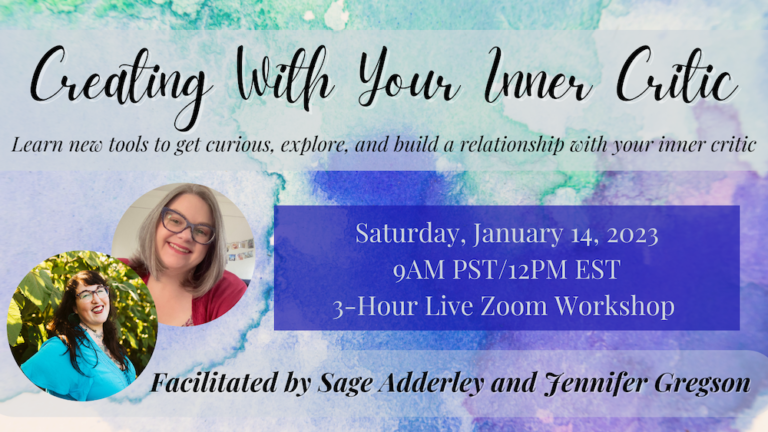
I am co-teaching a live Zoom workshop with my friend and fellow book coach, Sage Adderley, in January all about Creating With Your Inner Critic. 


Sage will be teaching you how to process emotions, thoughts, feelings and limiting beliefs using an intentional creativity process called Cosmic Smash Booking. She’ll be taking you on a journey with the relationship you currently have with your inner critic, that voice that tells you that you are no good, why bother, you’ll never be a writer. Cosmic Smash Booking goes beyond journaling to a spiritual release of emotions so you can move through them, work with them, and move past them.


For my portion of the workshop, I’ll be teaching how to use Tarot, Oracle, or other images to personify that inner critic so you can start talking to them, building a healthy relationship with them rather than reacting to them, so you can start writing without the inner critic stopping you from the brilliant words that I know are inside you. 


Creating With Your Inner Critic
will allow you to trust your own intuition so you can get unstuck and start that book that’s sitting on your heart and in your soul. 


Join us on Saturday, January 14, 2023 at 9 AM PST / 12 PM EST for a 3-hour Live Zoom workshop – valued at $597, it’s yours for $147 until December 31st so sign up below!!

Join Creating With Your Inner Critic Workshop HERE

My Favorite Writer’s Block Cure

Posted on September 29, 2022October 6, 2022 by Jennifer Gregson

Have you ever experienced writer’s block? If you have, you know that it can cause frustration, depression, anger and some fear. Fear that you may never write again.


I understand….because I’ve been there!  


There were literal months when I could not sit down and write. And one of the biggest things that I’ve done to help me combat writer’s block was to befriend my inner editor. Today I’m going to share three ways you can work WITH your inner editor rather than let them work AGAINST you.


Personify your inner editor


To start, choose an image that personifies that inner negative voice that you have.  I use Tarot cards for this, but you can use an image out of a magazine or Pinterest. You can even draw a picture of what you think your inner editor looks like – just have something visual that you can use to talk to your inner editor. 


Communicate with them


I personally start this step in a journal, but you can also type it out in a document, talk out loud to your image, or even film yourself so you can take notes later.   Get comfortable, look at your image and start asking questions


  • Why are you such a pain in my butt?
  • Why are you giving me such trouble?
  • Why do you cause me issues so I can’t even sit down to write?

Ask these questions and then wait for the answers. Yes, this seems silly, but we do this with our characters right? Personifying your inner editor, creating that character, allows you to talk to them and start befriending them, as if they were in one of your novels.


Hopefully these answers can help you understand your inner editor, your negative voice, a little better.  I have a theory that our inner critics are actually there to help us, but they don’t know how to do that, so they take the little bit of fear and self-doubt we already feel and amplify it to get our attentions like that’s magically going to make things better, but it doesn’t help! This process will help you talk to your voice and let them actually help you in a way that works for you.


My inner editor, who I call Dude, told me that he gets upset when I don’t write enough details in first draft – but that’s not important to me, so we had to talk awhile and I made him feel like I heard him and that I will come to him during 2nd and 3rd drafts to help me add in the missing detail. He’s really good at that stuff too.


So, ask some questions, get some answers and write down all that good information.  Ask some more questions, get some more answers and keep digging until you feel pretty good about what your inner voice is trying to tell you.

Ask them what they are good at


Now that you have that baseline communication done, you feel like you’re understanding each other a bit more, now you can ask them what they are good at, what they can help you with. 


You might already have come up with some ideas during your initial conversion, like I did with the details, but if not just ask them.  They might be great with settings and world building, names, or remembering things that are hard for you – like hair or eye color of characters.  Maybe your inner editor really wants to help when you are all finished and starting the marketing and publishing process. 


If you don’t get an answer right away, that’s fine – jot the question down on a post it note or index card and pay attention as you go about your normal writing sessions.  I bet you good money that voice will pop up at some point and tell you what you are doing wrong, or what they might be able to do better, and that’s the golden nugget – that’s the information that will help you decide what jobs you can give them. 


Process takes time


Just like any friendship, this process isn’t going to happen overnight.  It can take weeks, months, even years to get into the perfect rhythm with your inner editor, but just starting this process can help unlock some new things within your brain that will help keep writer’s block at bay.   And the card or image you chose might change as you and your inner voice keep working together.  I’ve been doing this work for almost a decade and I just recently changed the card I use for my Dude, one that’s more playful and colorful and feels more like the relationship we have now – so don’t feel like you have to get the perfect or right image, just find one that resonates with you now and start talking to them.


Let me know in the comments below if you’ve tried this how did the process work for you? And if this is something you might be interested in learning more about, stick around, because I will be teaching a class on this subject with an amazing writer friend of mine in January 2023!!

The form you have selected does not exist.

4 Things I Do To Defeat Writer’s Block

Posted on January 5, 2022January 19, 2022 by Jennifer Gregson

Suffering from writer’s block can call one to feel guilty, shameful, and depressed.  I have four simple things that I do before, during and after my writing sessions that help me defeat writer’s block. 


Have a writing ritual

The beautiful thing about writing rituals is they can be pretty much anything you want! The key is to find a few things that help you get into the mood for writing and do them consistently.  I use Tarot cards, candles or essential oil diffusers, and music as my writing ritual.  These help me slow down and break away from my day, gives me a chance to journal or do some prewriting to help prime the well, and ground me into the scene I’m going to write. 


Having a ritual that you do every single time you sit down to write helps tell your body that it’s time to settle down, settle in, and start creating.  And even if the writing ritual is the only thing you get done that day, if you are consistent, eventually your brain and body will connect and words will start to flow. 


Keep your Big Why in mind

Before I start writing any book, I like to think about my Big Whys – both the specific book project and how it fits into my overall writing goals.  I like to keep this where I can see it so I can review if I start feeling disconnected or if writer’s block starts to creep in.  Reading it at least once a week might be helpful or re-writing it every so often might work better – try both and see what feels most helpful for you. Just make sure you are thinking about why you wanted to write this story in the first place to keep your motivation high and writer’s block at bay.


Befriend your Inner Editor

This is going to sound a little nutty, but I have befriended my inner editor.  We all have that negative voice, that inner critic that tells us – this doesn’t sound good OR no one is going to want to read this – which can affect our ability to sit down and write new words.  I don’t believe this voice can ever truly go away, but I do think if we work on making that voice a bit more friendly we can work with it rather than have it work against us. 


By becoming friends with my Inner Editor, I can give it jobs to do so it feels important and like it’s part of the writing team and therefore will leave me alone more often than not while I’m writing my drafts and editing. Now, I’ve chosen a Tarot Card that personifies my Inner Editor and then started a conversation with them in a journal – and yes, I wrote out both parts … Again, it sounds nutty but it works!

* If you think this is a cool idea, wait a few weeks as I have a whole blog post just about this concept coming up!  


Track your data

Every week I like to write down what worked this week, what didn’t work this week and what needs to be adjusted for the following week.  You can also do this every time you write as well, especially if you are testing writing times or rituals, by jotting down when you wrote, where you wrote, what rituals you performed and any other notes that will be helpful. 


If you track data you can catch problems before they become huge issues. For example, every time you sit down to write at 10am the words flow out of you with no issues but 2pm feels super hard to even write a sentence, let alone pages of words.  The trick here is to leave emotions out of it – yes, we want to note how you felt during your writing sessions, but I don’t want you to judge the amount you wrote.  It’s a fine balance but if you can take the judgement out and just look at the data you can see that 10am just works better for you – that’s good information, useful information that can help you plan out the next week’s writing schedule. 


Catching things early keeps us moving forward, rather than getting off the rails and then writer’s block just comes in and causes guilt, shame and depression all over again. 


I would love to know which of these four tips was the most helpful? Which one are you just itching to implement? 


And if these ideas got you excited to get back to writing, then I invite you to sign up for the waitlist for my signature course – Turn on the Tap – to get early intel and a discount the day before the cart officially opens in early February!!

The form you have selected does not exist.

4 Creative Ways To Name The Characters In Your Next Novel

Posted on December 22, 2021December 20, 2021 by Jennifer Gregson


Anyone can grab the baby name book off the bookshelf, or use any of the apps available, but I think there are more fun and creative ways to come up with character names. 


Start with the time period and country your book is set

If you’re writing from a book set in the United States in the 1980’s you are going to come up with very different names than if you’re writing about Japan in the 1800’s.  My name, Jennifer, was extremely popular in the late 1970’s, especially in the midwest, versus what’s popular name in baby names so make sure you keep these things in mind before you jump into books, apps, or your own imagination. 


Think about the main theme of your book

Let’s say you are writing a Young Adult romance novel with the theme of love conquers all.  I would use that word – love – and search for names that mean love.  Then I would brainstorm other words that make you think of love.  Romance, roses, chocolate and use those to help search for names. 

What chocolate brands are out there? Can they be used for last names? 

What rose varietals are there? Can they be used for last names?


Use movie and TV credits

Speaking of last names, one of my most fun tips is to use movie and TV credits to borrow/steal actual real names.  This works extremely well if you’re writing a story set in another country.  Find a movie on Netflix or Amazon from that country and use the credits to grab names.  Note: I would google the meaning just in case it comes up as something weird or contradictory to your book’s theme.   

Use Tarot cards

Who didn’t see this coming? I like to shuffle my deck, pull a single card, and concentrate on something small – like a river, a flower, or a city scape in the background – and just brainstorm all the possible names that come up for me.

For example, with a river, I might think of the character River Song from Doctor Who, who is played by the amazing Alex Kingston. Or my favorite flower is the Sunflower, so a nickname for my character might be Sunny.  City names were really popular for awhile so you might have an Austin or Brooklyn or London.

This can be used in many ways, so pull cards and have fun with this process!


Which one of these tips was your favorite? Which one are you going to try? I would love to know, so share in the comments below. 

And if you loved this, then I think you would especially like my free training – Novel Narrator: Creating Your Book’s Characters in 30 Minutes Using Tarot – which you can grab here.  


The form you have selected does not exist.

6 Questions To Get You Unstuck & Writing Quick

Posted on December 8, 2021December 5, 2021 by Jennifer Gregson

Experiencing writer’s block can cause you to feel all kinds of emotions from shame to guilt to anger and back again. If you are dealing with writer’s block and you’re afraid you’ll never write again, I have six questions that can help you get unstuck and back to writing again. 

Note, if you’re like me and you love using Tarot, you can turn these into a spread by putting the first three questions on top and the second three questions on the bottom.  Otherwise, grab your favorite journal and let’s get journaling!

Q1: What excites you about your current project?

Think back to when you first had the idea or when you first started writing. Jot down all the things that excited you – was it the character? Was it the conflict? The theme? 


Q2: What scares you about your current project? 

Are you worried that you’re not ready to write this book? Are you writing a new genre or trying something new with your writing? Just write down all the stuff that might be holding you back. 


Q3: Why do you think you’re having writer’s block? 

Honestly, I think deep down we know why we’re stuck. We don’t want to admit it to anybody else, or ourselves. So, take a deep breath and let the words flow. Don’t judge yourself – just get it all out and down on paper. It will seem less scary.


Q4: What is the block trying to tell you? 

The block might actually be there to teach you something. Do you need to slow down and figure something out? Are your character’s not talking to you so you need to deal with them a little bit?  Write down what you think might be causing the issue. 


Q5: What do you need to know to bust through that block? 

So what came up in the previous question that you can now deal with? Do you need to stop and interview your characters again? Do you need to slow down and go through your outline? Do you need to research something so you can continue writing?


Q6: What is one creative solution that you can use to bust through the block? 

Now comes the fun part. Brainstorm some creative ways that you can bust through the block. Maybe you need to walk and talk, right? Get an app on your smartphone that allows you to dictate your words so that you can walk around your neighborhood or walk around your house. That’s one idea, come up with a bunch and then choose just ONE to start with. 


I would love to know what your one creative solution was, so please let me know in the comments below, and know that Writer’s Block happens to the best of us, but with these six questions you should be back to the keyboard in no time.

Here’s Why You Shouldn’t Be Ashamed If You Are Suffering From Writer’s Block

Posted on March 30, 2021November 3, 2021 by Jennifer Gregson
Shouldn't be ashamed if you are suffering from writer's block

Feeling stuck or suffering from Writer’s Block is not fun, but it’s nothing to feel ashamed of. You know what I’m talking about. Someone asks how the book writing is going and you say things are good even though you haven’t technically sat down in days (or months) and actually written or edited anything.  You feel terrible, guilty, and some shame but you don’t have to.

What exactly is Writer’s Block anyways?  

Maybe you’re not writing at all and totally avoiding sitting down at your computer at all costs – your kitchen has never been more clean and organized though.

Maybe you are writing some, but you hate every minute of it and you’re starting to want to avoid that computer, the bathroom mold is calling your name. 

Maybe you’re feeling a bit icky about the words you are producing as nothing sounds right, nothing feels right, and you’d rather spend your precious writing time researching one tiny detail in your novel, make another mood board or playlist, and reading that new book that might help you write yours. Yes, all of those things are fun and very much needed (at least to me) but there’s a fine line between research and procrastination.

Creative Fatigue

We are all feeling wiped out – Pandemic, lockdowns, online school for our kids, Zoom meetings all day, no coffee shops to write at, no aimlessly wandering Target listening to other people’s conversations – it’s been hard and we are all feeling dry and burnt out so luckily, you are not alone.

Why do I say luckily? Because when we’re having writer’s block and we starting feel ashamed we think we alone are suffering, but the truth is we are all feeling degrees of this pandemic pickle (a phrase I coined because I hate pickles but love alliteration – and pickles are sour and that’s the feeling I sometimes get when blocks rear their ugly head) but we can do some things to help.

Change Your Routine

You probably can’t go to Starbucks or other coffee houses to write, but you can go to a different location in your house.  You can try hand writing a few pages if you’re used to typing (or vice versa) or go totally nuts and use the voice memo on your smartphone to speak aloud a passage, scene, or whole chapter.  Or use the voice memo feature to talk through issues you are having with your novel like a talk therapy session.

Journal

Like I mentioned a few blog posts back you can journal as if you are one of all of your characters which does help unlock some fun dialogue and patterns of speech for each of them, but you can also just journal about your book. What do you like about your story? What are you not liking right now? What do you love about your main character? What do you hate about them? What do you love about your antagonist? What makes them the perfect villain? Sometimes we get so wrapped up in the day to day grind of writing that we forget why we started writing our current WIP in the first place. Why do you love your story? What was the inspiration? 

Talk It Out

Do you have another writing friend? Ask them how they’re feeling and let them know what you’re feeling and see if you can help each other out.  If none of your friends are writers, turn to Facebook or another group online (Discord has quite a few) to share what you’re feeling and let others offer advice.  Being honest and authentic with others allows them to be open and honest back and to let them see that they are not alone either.  

Don’t Beat Yourself Up

It’s hard right now. Writer’s Block is always hard (even without being in lockdown) but please don’t beat yourself up that won’t help anything and will only make you feel worse. Instead, give yourself some grace.  Talk to yourself the way you would your child or your best friend if they were having this issue.  Make your favorite hot beverage and tell that beautiful writer in the mirror that tomorrow will be better. 

Do Something

Write something…even if it’s one sentence.  Edit something…even if it’s one paragraph.  In fact, it’s better to restart slowly.  Make a plan to write for 1 minute and then stop. Do that for a few days and see if you’re itching to get back to it. If not, great – keep up with the one minute a day until you do feel better.  One minute a day is better than not writing at all for months on end. I know it seems silly, but trust me it will keep you connected to your novel, your story and your characters without driving yourself crazy.  It really is a win-win.

Celebrate

Look back at how far you’ve come.  Did you write one chapter before writer’s block? Great! Did you get through a whole draft but editing is causing you problems? Awesome!  Celebrate what you’ve done and see that you can and will write again.  Celebrate that you are aware of your problem and you are taking steps to fix them. Smile at that beautiful writer in the mirror and celebrate that you are a Writer – own it, claim it, call it, shout it out loud and proud. You are a beautiful writer and I never want you to forget it!

Which one of these tips and tricks are you going to try first? I would love to know.

The form you have selected does not exist.

3 Things To Remember When You Are Feeling Stuck

Posted on March 15, 2021November 3, 2021 by Jennifer Gregson
Things to Remember when you are stuck

You used my tips from my last blog post and your characters are talking to you again, the words are flowing, and you are feeling on top of the world…until you aren’t. You just can’t get into the groove, words sound stilted, your dialogue sounds like a kindergartener wrote them, you are just feeling stuck. 

Why? What’s happening?

You have the dreaded writer’s block, even though you can’t seem to admit that to anyone – not even yourself – you know you are avoiding your laptop, or that Scrivener file – and it’s starting to affect your mental health.  You are letting your past issues affect your present and it sucks.

You Are Awesome

First, don’t lose sight of how amazing you are.  Just because you are stuck right now and you’ve had some issues sitting down and getting quality words down on paper – and you’re probably starting to feel crappy – remember that you are awesome.  You have had days and months of writing amazing things, quickly and in total flow which means you can get back there again.  

You Are Magic

Secondly, remember that everything you need is inside of you – right now and always! You just might need some help.  Another person to talk things out with (like a Tarot Reader who specializes in helping writers perhaps?) or just a day or two where you don’t stress about the words.  Journal, interview your characters, try something else, build a playlist, dance, draw, do anything else to get out of your own way.

You Are Going To Be Okay

And finally, realize that things might look different.  You might have planned and made a detailed outline and then your main character did something to screw everything up, but after you looked at it – it’s actually pretty brilliant. Or maybe you don’t outline but you had some ideas and nothing is panning out the way you thought…but what you are writing is actually funny so go with that.  OR maybe you wanted to write fantasy but aliens keep popping up – okay, take a step back and see if you really, deep down want to write Science Fiction?  It’s all OKAY, trust me.  Go back to step two and remember that you are magic!

How are you feeling now? Can you take a deep breath, remember how magical and awesome you are, and try again?  Let me know how it goes below.

The form you have selected does not exist.

  • July 25, 2025 by Jennifer Gregson How to Use Headings and Flourishes in Book Formatting: A Fun Guide for Indie Authors
  • July 18, 2025 by Jennifer Gregson Book Formatting Terms Every Indie Author Should Know: Lingo 101 for Self-Publishing
  • July 18, 2025 by Jennifer Gregson Don’t Leave Your Reader Hanging: What to Include in the Back Matter of Your Self-Published Book
  • June 27, 2025 by Jennifer Gregson Front Matter 101: What Every Self-Published Author Needs Before Chapter One
  • June 20, 2025 by Jennifer Gregson How to Pick the Perfect Trim Size for Your Print Book (with Examples!)
© 2026 Jennifer Gregson | Powered by Minimalist Blog WordPress Theme